

By Selwyn Duke
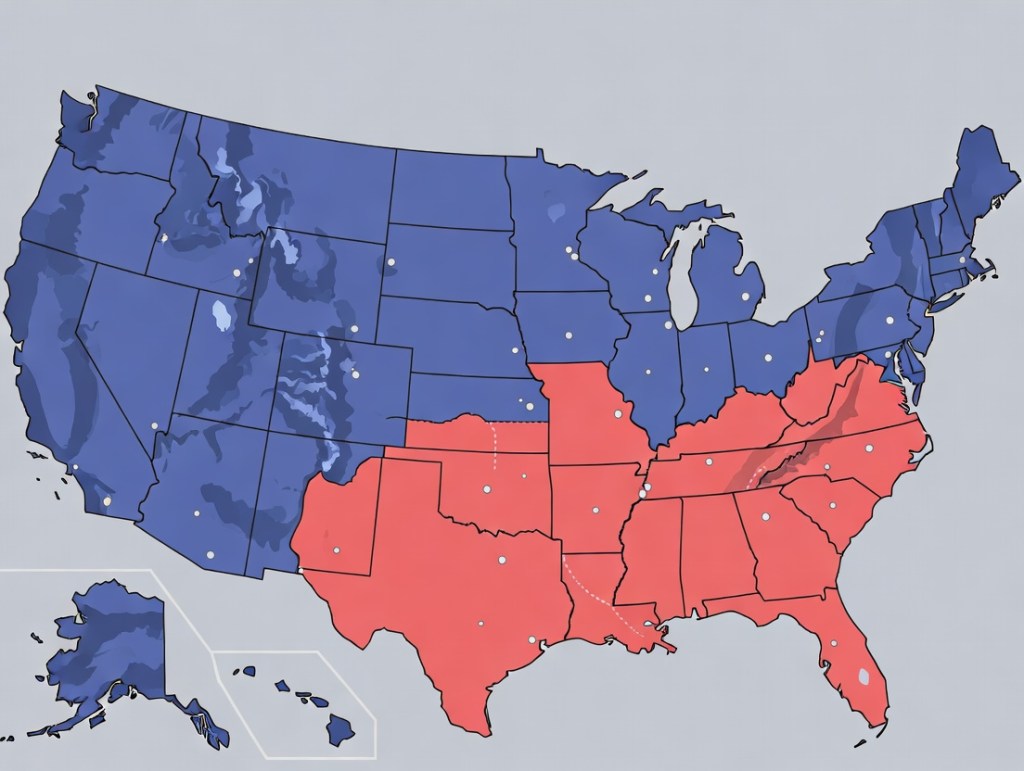
It’s not just economic activity that has been moving from a waning North to a burgeoning South in recent times. Intellectual activity is also making that move — contrary to stereotypes.
Just consider Mississippi, a state oft mocked by urban arts-and-croissant pseudo-sophisticates. Leading the post-Covid recovery, it has gone from 49th to seventh nationally in fourth-grade reading scores. This is even though it’s still our poorest state.
Moreover, this just reflects a wider phenomenon dubbed the “Southern Surge.” It’s no mystery why it’s occurring, either. Unlike in liberal northern bastions, southern states have embraced not only early intervention, but also traditional learning and a very “unwoke” concept: discipline.
This is the matter’s nub, too, because, as I’ve often stated, discipline and obedience are prerequisites for learning. Why? Because someone can’t learn from you unless he’s first willing to listen to you. Listening is a condition for learning.
The South Is Rising
Reporting on the Southern Surge, the New York Post wrote last week:
According to Harvard’s 2024 Education Recovery Scorecard, Louisiana is the only state to recover to 2019 achievement levels in both reading and math, while Alabama matched pre-COVID scores in fourth-grade math alone.
All other states continue to lag prior achievement levels.
Much of this success has rightly been credited to a handful of commonsense reforms: early literacy laws that require the use of phonics, the tightening of retention and promotion policies, universal literacy screeners in early grades, and rigorous curricula.
None of this is rocket science. Remember, too, what it represents: the embracing of what’s tried and true.
Phonics, for example, has been used to teach reading for 450 years. We know it works.
When schools adopt some new pedagogy that’s often younger than many of their students, however, they’re essentially using the kids as guinea pigs. It’s frequently done for the wrong reasons, too.
One is chronological chauvinism, the idea that “old” is synonymous with inadequate and “new” with superior. It involves the worship of what births the new: change. But it also ignores something G.K. Chesterton noted long ago.
“Nine out of ten of what we call new ideas,” he wrote, “are simply old mistakes.”
A second reason is money. School systems spend millions of dollars on new teaching paradigms. This allows them to say, “We’re embracing pedagogy based on the latest findings!” And for-profit consulting firms such as Pacific Educational Group rake in millions delivering educational snake oil.
That Prerequisite
Yet another factor in southern states’ educational success involves an even more important embrace of tradition. That is, the Post writes, their “strict disciplinary policies.”
Not coincidentally, the educationally surging states are the ones securing intra-school order and stability, the paper informs. For what good are sound curricula and ideal instructional methods if classrooms are chaotic? Children can’t learn in what’s essentially a war zone.
Teachers can’t teach in one, either — and many good ones won’t. In fact, troves of educators have been quitting at record rates in recent years, wrote City Journal (CJ) last summer. The outlet then provided an exemplative anecdote:
Longtime educator Ben Foley is one of many who found the situation unbearable. After more than two decades teaching middle school in California, he resigned midyear, worn down by classrooms that had descended into chaos. He described the daily environment as “anarchic,” with students routinely ignoring basic instructions, roaming the room, throwing things, and roughhousing. Foley likened the experience to “death by a thousand cuts,” explaining that “for every request I make, several kids flat-out defy it.”
Of course, the above won’t be news to anyone who has been paying more attention to our culture than the kids do in school. CJ also relates something else. “Foley blamed the breakdown,” it writes, “on lax discipline practices introduced under Positive Behavioral Interventions and Supports (PBIS).”
What is PBIS exactly? The details are irrelevant. All that’s significant is that it, CJ writes, “masks” an “anti-punitive bias.” It’s simply permissiveness — which has permeated parenting and school policies for decades — with a pseudo-intellectual veneer. Just as with “whole language” programs, generally used to supplant phonics, it’s another old mistake disguised as a new idea.
Common Sense Down South
Returning to the Post, it points out the obvious with discipline: “One bad apple spoils the whole bunch.” Tolerate misbehavior from one child, and many other kids will follow suit. Despite this reality, the Post tells us,
blue and red states frame discipline differently.
Alabama’s regulatory codes, for example, open with a statement that “students be allowed to learn in a safe classroom setting where order and discipline are maintained,” and that “every child in Alabama” is entitled to “the right to learn in a non-disruptive environment.”
Boundaries and order are treated as inherent goods.
Many blue states, however, view school discipline as a necessary evil, to be limited as much as possible.
California prohibits the use of suspensions for low-level misbehavior such as willful disobedience.
Massachusetts imposes prerequisites on the use of suspensions, telling administrators that they “shall not use suspension from school as a consequence until alternative remedies have been tried and documented.”
The result? Southern schools’ disorder levels have remained stable from 2019-2022. Disorder increased during that period, however, in northeast-, Midwest-, and western-region schools — and is much higher than in southern ones.
Much of what drives this is, again, our age’s permissive spirit. Another factor, though, is a racial politics that mandates children be punished based on group quota. Left-wing jurisdictions and the Barack Obama administration pushed this 15 years ago already, too. And why?
Because black and Hispanic students were being suspended and expelled at higher rates than were white kids.
(Of course, no one complained about whites and boys being punished more often than, respectively, Asian-descent students and girls.)
Do This — or All Bets Are Off
The Post further illustrates the problem and solution. Here’s a summary:
- Conservative states are proactive and nip problems in the bud before they escalate.
- States such as Alabama and Tennessee have granted teachers more authority to remove disruptive students and require administrators to impose consequences.
- Core argument: Orderly, safe classrooms are essential for learning; discipline should not be a last resort but a foundational tool.
- Recommendation: To improve academics, we must prioritize strong behavioral foundations by strengthening discipline policies.
Yet even this may understate the reality. Attempting education without first ensuring discipline is a waste of time — and money. And we shouldn’t provide resources to “educators” content to be zookeepers. For once again, a person can’t learn from you unless he’s first willing to listen to you.
Really, this is much as with a father who doesn’t spend time with his kids but just showers them with money. As a society, we’ve become too pusillanimous to do what really must be done in education. So instead, we just throw money at the problem and hope no one will notice.
This article was originally published at The New American.

 selwynduke.com
Let us know what you think, dear reader. We value your input!